What Is Depreciation Accounting? a Clear UK Guide
Discover what is depreciation accounting, how straight-line and reducing balance methods work, and how UK capital allowances differ from it.
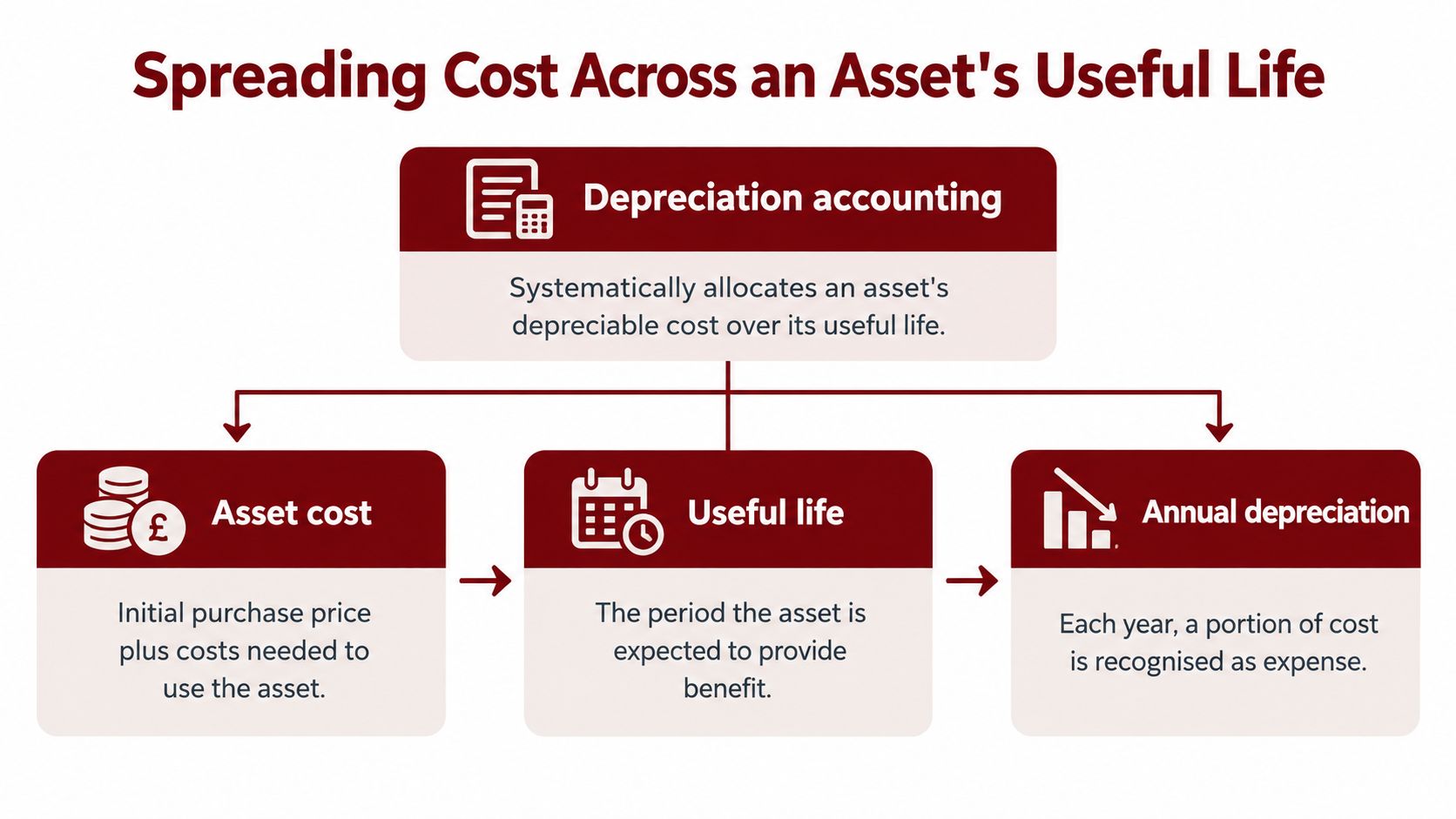
Depreciation accounting spreads an asset's depreciable cost, after deducting its residual value, across the years the business expects to use it to generate economic benefits. A £60,000 machine with a £6,000 residual value and a five-year life produces £10,800 of annual depreciation in the accounts, and that charge is not the deduction HMRC works out through capital allowances.
You've probably just bought something that should earn its keep for years. The bank balance dropped on day one. If the whole cost landed in this year's profit, the business would look weaker than the trading was. The accounts are trying to tell an economic story, not a cash diary. Tax then takes its own route, with statutory pools and rates, so the figure that cuts taxable profit can move on a different timetable from the figure in your management accounts.
Table of Contents
- Why Assets Lose Value Before They Wear Out
- Spreading Cost Across an Asset's Useful Life
- Choosing Between Straight-Line, Reducing Balance and Units of Production
- Working Through Depreciation Calculations and Journal Entries
- Reading the Effects on Profit, Balance Sheet and Tax
- Sector Notes and Common Pitfalls for Builders and Landlords
- Recordkeeping, Accountant Support and Your Next Step
Why Assets Lose Value Before They Wear Out
Maya runs a small fabrication shop in Kingsbury. She buys a cutting machine because orders are stacking up. Cash leaves the bank on the purchase date. Months later the profit and loss looks softer, even though no further payment left the account for that machine.
That gap is what depreciation accounting is for. The purchase isn't a one-day cost. The machine will help earn revenue for several years, so the accounts spread its depreciable cost across those years. Profit falls by a slice of the cost each period. Cash doesn't move again when you post the charge.
Think of a van you fill once for a long job. You don't treat the whole tank as belonging only to the first mile. You match the fuel to the distance. Depreciation does the same job for a long-lived asset. It matches consumption with the revenue the asset helps to earn.
Who feels this first
Startups, SMEs, contractors and landlords hit the same confusion in different clothes.
- Founders see profit dip after a kit purchase and assume trading has weakened.
- Contractors wonder why plant still sits on the balance sheet after the invoice is paid.
- Landlords mix the accounts charge with the tax claim and adjust the return the wrong way.
The accounts measure expected consumption. They don't measure rust, and they don't measure the tax relief.
You want four practical outcomes from here. You should be able to say what the charge is, turn cost and life into a yearly figure, post it so profit and the balance sheet both move, and see where capital allowances split away from the accounts. The machine can lose accounting value before it looks worn out, because technology, usage and your replacement plan can shrink the remaining life while the metal still looks fine.
Spreading Cost Across an Asset's Useful Life
Four building blocks sit under every schedule. Get these wrong and the formula won't save you.
Cost is what you paid to buy the asset and bring it into use, including delivery and installation where those are needed to operate it. Residual value is what you expect to recover at the end, often a trade-in or scrap sum. Useful life is how long, or how intensively, you expect to consume the benefits. The depreciation method is the pattern you use to spread the depreciable amount, which is cost minus residual value.
Straight-line fits even consumption. Take that £60,000 machine, subtract the £6,000 residual value, and you have £54,000 to allocate. Five equal years gives £10,800 a year. The expense cuts accounting profit. It isn't a cash payment, and it isn't a market price. FRS 102 guidance from the FRC treats this as systematic allocation over the period you expect to consume the benefits, and it asks management to reassess useful life, residual value and the consumption pattern at least annually. Climate-related factors belong in that review where they shorten lives or change how the asset is used.
A van or a laptop rarely gives you all its value on the day you buy it. Year one and year four can both depend on that kit. Spreading the cost stops one year's profit from swallowing a multi-year tool.
When the estimate has to move
If faster obsolescence means you'll replace the machine after three years, you change the estimate from that date forward. You don't rewrite earlier years as if the original life was a blunder, unless the original entry was wrong. New evidence is an estimate change. A missed invoice is an error. Those two are not the same job.
Practical rule: tie useful life to expected usage, maintenance, obsolescence and your disposal plan, not to a trade rumour.
Founders sometimes look at MACRS depreciation rules for rental properties to see how another tax system locks recovery into fixed periods. That contrast helps, because a statutory timetable isn't the same thing as expected consumption in your UK accounts.
Choosing Between Straight-Line, Reducing Balance and Units of Production
The method is a story about how the asset is used. Pick the story that matches the work, then stick with it unless the evidence changes.
Straight-line gives the same charge every year. It suits assets whose benefits arrive evenly, such as office fit-out, shelving, or a machine that runs a steady shift pattern. The records you need are simple: cost, residual value, in-service date and the life you chose.
Reducing balance applies a fixed percentage to the carrying amount that is left, so the charge is larger early and smaller later. It can suit vehicles and equipment that give more of their economic punch in the first years, or that you'll replace before the tail of the life. You need the opening carrying amount each year, not just the original cost.
Units of production ignores the calendar and follows output. Hours, tonnes, or jobs drive the charge. It suits plant that sits idle in some months and runs hard in others. You need a credible total of expected units over the life, plus a reliable count of this year's usage. If the usage log is fantasy, the method is fantasy.
Depreciation Methods at a Glance
| Method | Annual charge pattern | Typical asset fit | Records needed |
|---|---|---|---|
| Straight-line | Equal amount each year | Fit-out, steady-use machinery | Cost, residual value, life, start date |
| Reducing balance | Percentage of the remaining carrying amount, so the charge falls | Vehicles, kit that loses usefulness early | Opening carrying amount and the chosen rate |
| Units of production | Rises and falls with actual output | Plant with variable hours or volume | Expected lifetime units and this year's usage |
Choose the pattern that reflects consumption, and apply it consistently inside that asset class. A different pattern for a different class is fine. Changing method because this year's profit looks awkward isn't. If usage, technology or your replacement plan shifts, you revise the estimate. You don't shop for a method after you've seen the profit.
Working Through Depreciation Calculations and Journal Entries
You can reproduce both the accounts charge and the tax computation in a simple spreadsheet. Keep them on separate rows. They answer different questions.
Straight-line in the accounts
- Start with cost and subtract residual value. That difference is the depreciable amount.
- Divide by the useful life you expect, in years or months.
- Post that amount each period while the estimate still holds.
On an £80,000 asset with no residual value and a five-year life, even spreading gives £16,000 a year. That is an accounting allocation. It doesn't describe what left the bank, and it doesn't have to match the tax pool.
A falling tax balance, not an accounts rule
Where qualifying plant and machinery doesn't get another first-year relief, HMRC uses writing-down allowances on pooled expenditure. For periods before April 2026, the main pool rate was 18% on a reducing-balance basis and the special-rate pool was 6%, and the main rate had stayed at 18% since 2012, as set out in HMRC's note on the new first-year allowance and writing-down rates. An £80,000 main-pool balance produces a £14,400 deduction at 18% in the first year, leaving £65,600 before other adjustments. The next 18% deduction is £11,808. The deduction shrinks because the percentage hits a smaller balance.
The same HMRC publication sets out faster routes for companies. Full expensing allows a 100% deduction for qualifying new and unused main-rate plant and machinery bought from 1 April 2023. A 50% first-year allowance applies to qualifying special-rate assets. Those are tax computations. Your accounts can still use straight-line, or another method that reflects how you consume the asset.
Units of production without a fake total
Multiply cost less residual value by the units you used this year, then divide by the total units you expect over the life. No percentage is hiding in that sum. If the hour meter or job count isn't trustworthy, don't pretend the method is more "accurate" than straight-line.
The journal, every period
Debit depreciation expense. Credit accumulated depreciation. Expense hits profit. Accumulated depreciation is a contra-asset, so the carrying amount on the balance sheet falls by the same figure without wiping the original cost off the nominal ledger. If you're still mapping which accounts those postings live in, the nominal ledger guide is the place to pin the codes before you automate the entry.
Carrying amount is cost minus accumulated depreciation. Lenders often watch that net figure, not the original invoice.
Reading the Effects on Profit, Balance Sheet and Tax
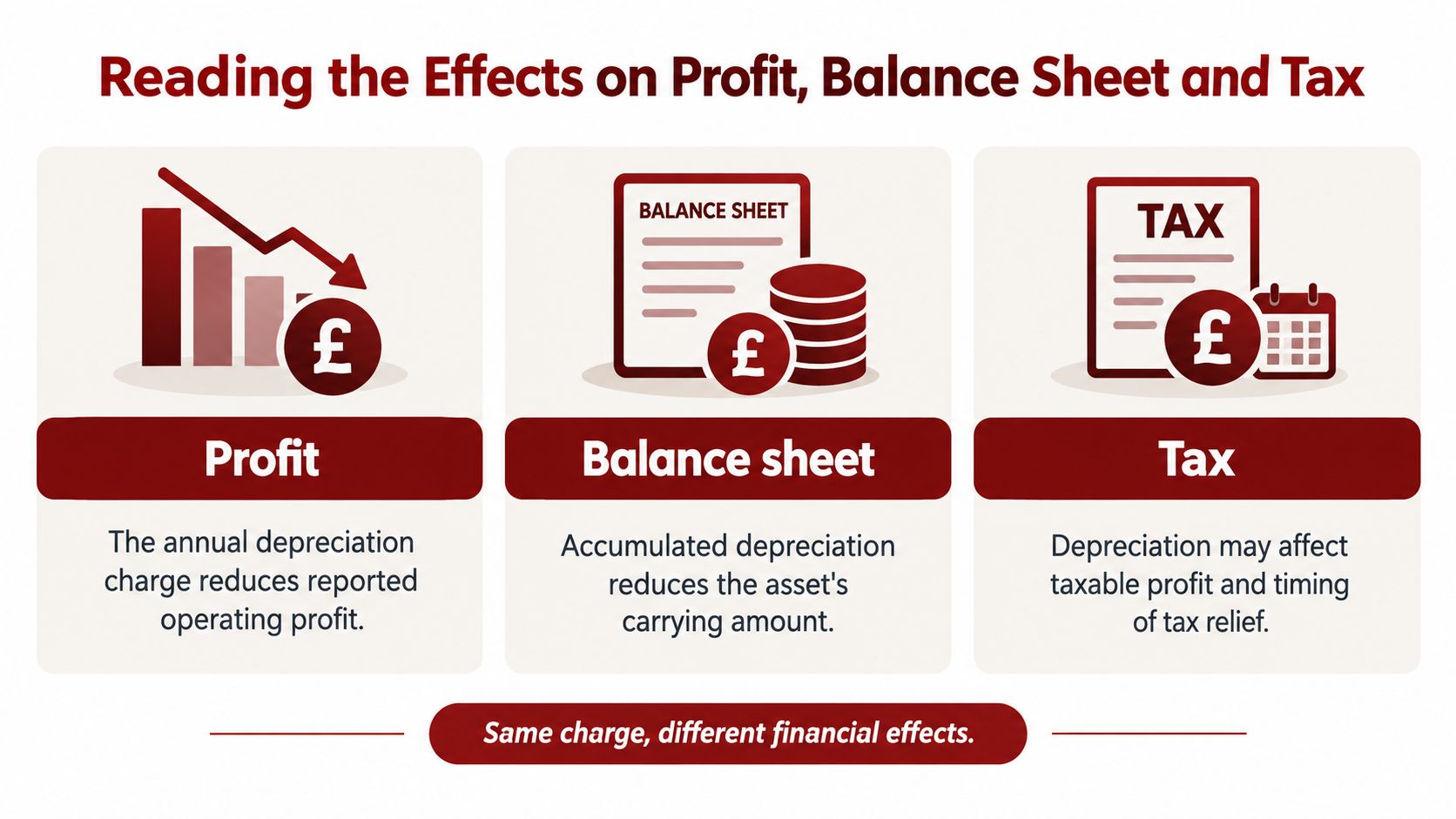
The annual charge reduces reported operating profit. Accumulated depreciation reduces the asset's carrying amount, which feeds net assets, asset turnover and ratios that sit inside loan covenants. A lower carrying amount can also bring an impairment question forward if recoverable amount has fallen further. None of that is a cash outflow. It's a measurement of consumption.
Where the tax figure splits off
In the UK, depreciation in the accounts is distinct from tax relief. HMRC's capital allowances manual records that an investment allowance arrived in 1954 to encourage plant and machinery, initially 10% for agricultural and industrial buildings and 20% for other qualifying assets. A later milestone was the Annual Investment Allowance, which HMRC describes as effectively a 100% allowance for qualifying plant and machinery, excluding cars, up to an annual limit. When introduced, that threshold was £50,000. HMRC states it was made permanently £1 million from 1 January 2019.
So a company can buy £80,000 of qualifying equipment, claim the allowance, and deduct £80,000 in that chargeable period, while the accounts still spread depreciation over several years. The books record the asset and the depreciation expense. The tax computation adds depreciation back and substitutes the capital allowance. Taxable profit and reported profit part company in the year of purchase, then can move back toward each other as later writing-down allowances, or further claims, unwind the gap.
That gap is a temporary difference. Where it matters for statutory accounts, you deal with it through deferred tax rather than by forcing the accounts to copy the tax pool. The practical cash-flow point is simple. An immediate allowance can cut this year's taxable profit and bring relief forward. Slower accounting depreciation only spreads the expense in the performance story.
For property businesses, the same split shows up when you sort repairs from capital spend. The allowable expenses guidance for rental income is a useful companion when you're deciding what never enters a depreciation schedule at all.
Reconcile the fixed-asset register to the capital-allowance pools. Separate qualifying plant and machinery from spend that doesn't qualify. Keep disposal proceeds, because a sale can trigger a balancing charge or a balancing allowance. Accounting depreciation on its own doesn't set the corporation tax deduction for an SME buying vehicles, tools, machinery or construction equipment.
Sector Notes and Common Pitfalls for Builders and Landlords
A single life for "all the plant" is a habit, not a principle. It fails as soon as the parts don't wear out together.

Construction plant isn't one asset
For contractors, a vehicle chassis, a specialist attachment and a major overhaul can have very different replacement cycles. One blended life flatters the long-lived part and undercharges the part you'll swap next season. Component estimates, each with its own cost and life, track consumption more accurately. Accounting for construction contractors is where CIS and sector records sit alongside that asset discipline.
Recent UK investment patterns show why a static life is risky. ONS business investment figures show business investment rose 3.9% in Q1 2025, fell 1.1% in Q2 and rose 1.5% in Q3, with ICT equipment, machinery and intellectual-property products among the drivers. Across 2025, UK business investment increased 4.3%. For a North West London SME, software, computers, construction kit and vehicles can make an original five-year life look unrealistic well before year five.
Landlords and the mistakes that bend profit
Buildings, fit-out and furnishings don't share a life. Check the accounting estimate and the tax position side by side. Furnishing that you replace often shouldn't hide inside a 50-year building life.
The mistakes that distort the numbers are ordinary:
- Frozen lives: you keep the original useful life after technology or usage has moved.
- Estimate versus error: you "correct" prior years when new evidence only justifies a forward change, or you do the reverse and leave a missed asset unposted.
- Idle on the register: assets still in use attract no charge, so profit and net assets stay too high.
- Silent disposals: sold or scrapped kit stays on the books, and the tax pool never sees the proceeds.
Under-depreciating obsolete assets overstates profit and net assets. Aggressive charges do the opposite and can make a healthy job look weak to a lender. Neither outcome is "prudent" by default. Both are judgement calls you should be able to evidence.
Recordkeeping, Accountant Support and Your Next Step
The register is the bridge between the economic story and the tax computation. If it only lives in someone's head, both figures drift.
Keep one row per asset, or per component where the cycles differ. Record acquisition cost, in-service date, residual value, useful life, method, accumulated depreciation and carrying amount. File the invoice with that row. When you sell or scrap, record the date and the proceeds, then remove cost and accumulated depreciation together so a gain or loss is visible.
A yearly rhythm that stays small
- Reconcile pools: match the register to capital-allowance pools, and mark what never qualified.
- Review lives: once a year, write down why a life, residual value or method still fits, including obsolescence and disposal plans.
- Catch movements: additions, disposals and assets brought into use mid-year shouldn't wait for the accounts rush.
Talk to an accountant when you buy or sell a major asset, when you incorporate, when a balancing charge or allowance is in play, or when lives change enough to move profit and covenants. A practice such as Action Accountants Limited, Certified Public Accountants based in Colindale, can take that review alongside bookkeeping, statutory accounts and tax returns for startups, SMEs, contractors and landlords. Other firms cover the same ground. What matters is that someone holds both the register and the pools in one conversation. The year-end accounts checklist is a sensible prompt before that meeting, so you're not reconstructing additions in March.
List every asset you still use. Note its cost, its in-service date and whether the original life still matches how you work. Bring that list to a review before the next year end, while invoices and disposal notes are still easy to find.
Action Accountants Limited helps founders, contractors and landlords in North West London and across the UK keep asset registers, statutory accounts and capital-allowance claims aligned. If your plant, vehicles or rental assets are still on a static spreadsheet, a structured review before year end will show where the accounts charge and the tax deduction diverge. Visit Action Accountants Limited to book that review with the team.